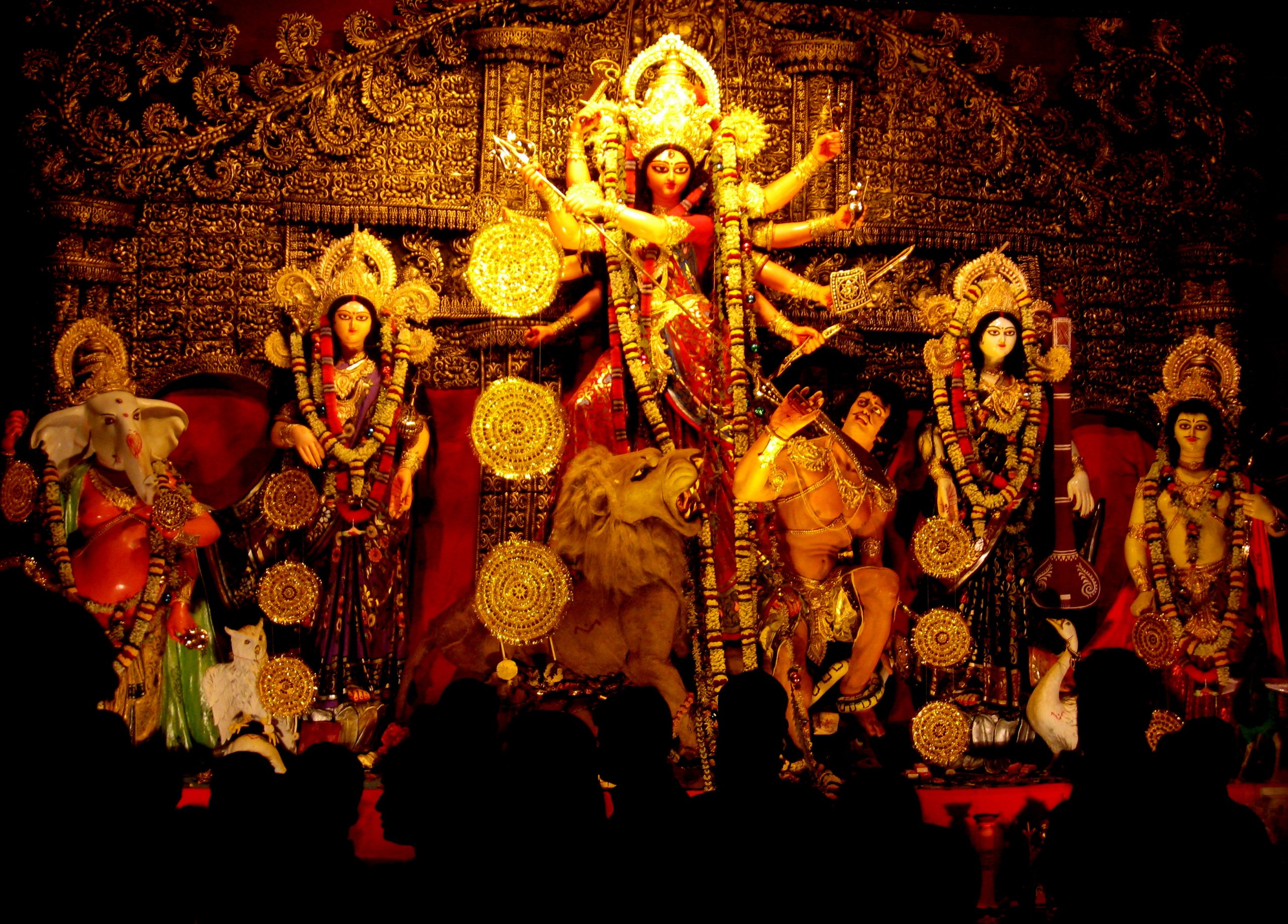
Nine Days of Navratri
Navratri, a nine days long festival is held in honor of the divine feminine in the Hindu calendar. The Sanskrit translation of this word means nine nights which are solely dedicated to goddess Durga and her nine avatars. Navratri falls during the month of Ashivan/Ashvina (i.e. usually September-October) which ends with the Dusshera (Vijaya Dashami) celebration on the tenth day. The festival is celebrated as a victory of the good over evil by Hindus with great devotion for 10 days.
Though Navratri comes two times a year i.e. Vasanta Navratri (celebrated in the month of March-April and ends with the celebration of Ram Nawami) and Sharadha Navratri (celebrated in the month of September-October), the most popular is the one that falls in the month of September-October. However, the dates of Navratri changes every year because it is based on the lunar calendar.
The popular story related to Navratri is the fight that took place between goddess Durga and the buffalo demon Mahishasura. All the nine days of the festival are devoted to worship the nine forms of the goddess Durga (Nawa Durga) – Shailaputri, Brahmacharini, Chandraghanta, Kushmanda, Skandamata, Katyayani, Kaalratri, Mahagauri and Siddhidatri. It is believed that each goddess has a different form and a special meaning. Here is the detail of the nine forms of Goddess Durga:
Shailaputri (1st Form)
Shailaputri, also known as Sati, Bhavani, Parvati or Hemavati was the daughter (putri) of the king of the Mountains (Shaila) and was thus known as “Shailaputri”. The goddess is considered the absolute form of Mother Nature. Popularly known as Parvati, she is the wife of lord Shiva and has Kartikeya and Ganesha as her sons. In her previous life, she was the daughter of Daksha as Sati and was the spouse of Shiva. She had burnt herself in the fire of Yagna when her father Daksha insulted her husband. Thus, she was reincarnated as Parvati and was again married to Shiva. As per Upanishad (ancient sanskrit texts), she reduced the egoism of Indra and other gods and also is considered the manifestation of the power of Brahma, Vishnu and Shiva.
Goddess Shailaputri is considered as the epitome of patience. She is worshipped on the very first day of Navratri due to her never-ending glories. She is depicted riding a bull (Nandi) while carrying a trident in one hand and a lotus in the other.
Brahmacharini (2nd Form)
Bramhacharini means the one who practices sincere austerity. She is worshipped on the second day of Navratri. She is the unmarried form of goddess Parvati. Being reincarnation of goddess Sati, she practiced hard to be a soulmate of Lord Shiva under the guidance of Devarshi Narada. For more than thousand years, she only had fruits, beetroots, flowers and fallen leaves. Due to her unearthly penances, her body become extremely weak and fragile and in the end, Lord Bramha blessed her with the power that can fulfill her desire of marrying Lord Shiva.
The idol of Bramhacharini is shown as a hermit holding a Khumbha or water pot on left hand and rosary on right hand. She is dressed in the orange attire symbolizing her sacrificial path of life. Goddess Bramhacharini is the store house of knowledge and wisdom who teaches penance, devotion, restraint and solitude.
Chadraghanta (3rd Form)
Goddess Chandraghanta is worshipped on the third day of Navratri. Chandra-ghanta means the one who has half-moon shaped like a bell. She is held synonymous to calm and peace. Her story is narrate as follows: When lord Shiva came in a terrifying form at Parvati’s place with the marriage procession, accompanied by gods, mortals, ghosts, sages, etc., Parvati appears as Chandraghanta and persuades him to change his terrifying form to more charming one.
She possess ten hands holding a Trident, Mace, Bow Arrow, Sword, Lotus Flower, Bell and Water pot. One of her hands remains in blessing posture. She rides tiger or lion representing bravery and courage and has third eyes in the middle of her forehead.
Kushmanda (4th Form)
Kushmanda is the fourth aspect of the goddess Durga and is worshipped on the fourth day of Navratri. The meaning of the name Kushmanda is as follows: ‘Ku’- a little, ‘ushma’- warmth, ‘anda’ – the cosmic egg, so she is considered the creator of the universe. She is addressed as the companion of Lord Shiva who is the embodiment of happiness and harmony. She is generally shown riding on a tiger or a lion with each of her eight hands sword, hook, discus, mace, bow, arrow and two jar of honey and mace respectively.
There’s an interesting story about goddess Kushmanda. It is believed that the goddess created this cosmic egg and was the first being in this entire universe. Universe was no more than a void full of darkness, until her light spreads in all directions like rays from the sun. She is believed to bring wealth and health to her devotees.
Skandamata (5th Form)
The fifth day of Navratri is devoted to goddess Skandamata. Goddess Durga was named as Skandamata because she was also the mother of Kartikeya or Skanda. Legend says that the child of goddess Parvati and Lord Shiva brought an end to the great demon, Tarkashura. Tarkashura had asked a boon to Lord Bramha that no one can kill him except the son of Lord Shiva, thinking Lord Shiva would never get married. Goddess Skandamata is also a symbol of mother-son relationship.
The goddess is portrayed holding her son Skanda in his infant from in her left hand and a lotus in her right hand. She is also called Padamasini since she is demonstrated seating on a lotus flower. People worship her selflessly to get the blessing like a true mother from Skandamata.
Katyayani (6th Form)
Goddess Katyayani is worshiped as a 6th form of goddess Durga on the 6th day of Navratri. The story behind her name is said that there was a rishi named Rishi Katyayan, a true devotee of goddess Durga, who worshipped her for several years. When Durga was pleased with the hard dedication, she incarnated herself as the daughter of Katyayan and thus is known as Katyayani. In this form the goddess ended the pain and suffering imposed by demon Mahishasura and brought peace to the mankind, thus, she is also known as the warrior god.
Goddess Katyayani showers her blessings on those marriageable girls who worship her with full devotion.
Kaalratri (7th Form)
Kaalratri is worshipped on the 7th day of Navratri. She is the one who brings the end to the darkness and ignorance. She is the most terrifying emancipation of goddess Durga who has dark complexion, ruffled hair and a fearlessness posture. She is thought to have three eyes that shines bright and terrible flame emanated from her breath, and her mount is a donkey. She is commonly referred as Kali and is believed to be the destroyer of all evil things.
In this form the goddess killed a demon Raktabeej, who could multiply itsled from every drop of his blood if fallen on the ground. Kaalratri killed him by licking the blood before it could reach the ground. She blesses her devotes with calmness and courage.
Mahagauri (8th Form)
She is worshipped on the eighth day of Navratri. Her worship result to wash away all sins of past, present and future and one gets purified in all aspects of their life. Mahagauri means extremely white. Legend says that, due to goddess Parvati long austerity in the dense forest of Himalaya, she developed a dark complexion. And when Lord Shiva cleaned her with the water of Ganga, her body gained its beauty and came to be known as Mahagauri. There are other various version of this form of goddess Durga.
Mahagauri radiates peace and compassion and is often dressed in white or green sari while holding a drum and a trident riding a bull.
Siddhidatri (9th Form)
She is worshipped on the ninth day of Navratri. The goddess is the giver of all perfections (siddhis) and bestow happiness to her followers. It is believed that Lord Shiva one side of body is the body of Siddhidarti and therefore Lord Shiva’s name was famous as “Ardhanarishvar”. According to Hindu Purans, the goddess provides eight siddhis to her devotees: Anima, Mahima, Garima, Laghima, Prapti, Prakamya, Iishitva and Vashtiva. She has a supernatural power and is often portrayed as a goddess with four arms who rides lion as her vehicle.
Festival of Navratri is full of enjoyment, festivity and lights. Though celebration varies from one state to another the festival dedication and devotion remains the same all over the Hindu community.