
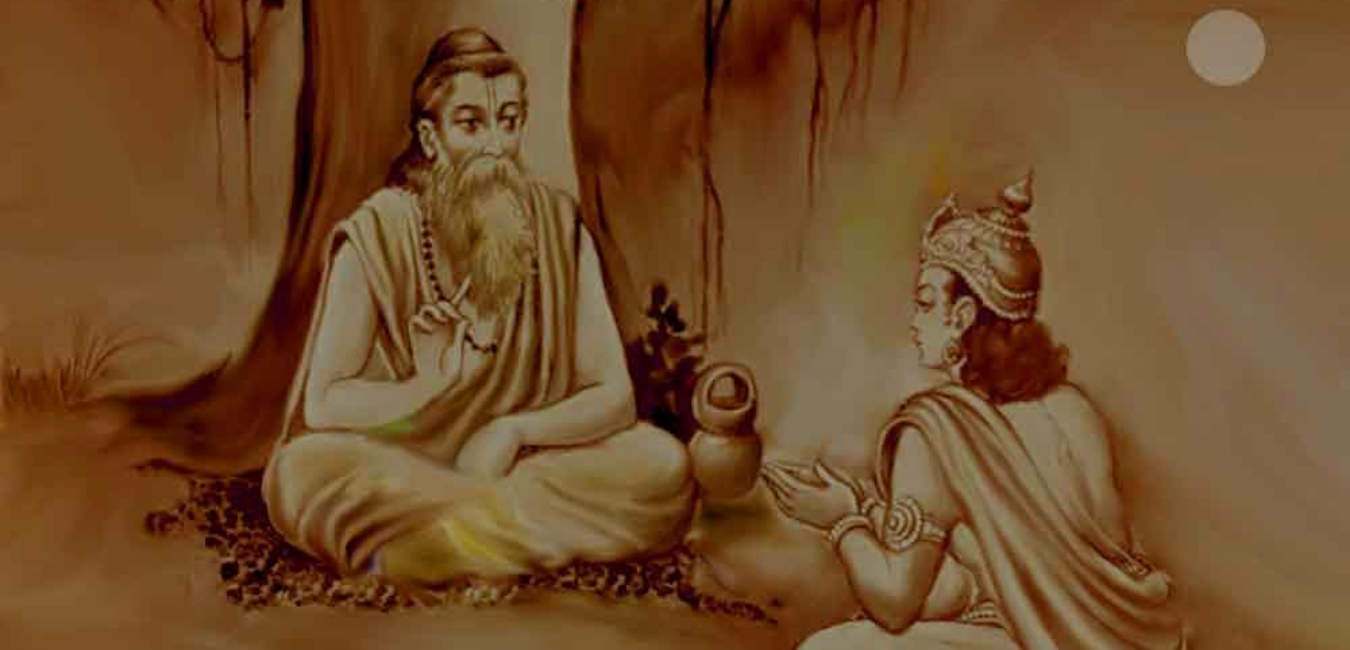
Ashtavakra is a revered Vedic sage in Hinduism. Ashtavakra means “eight bends”, representing the eight physical handicaps he was born with. He was physically challenged however he was intelligent as a child.
Ashtavakra is recognized as the author of the Ashtavakra Gita, which means “song of Ashtavakra“. The text is also known as Ashtavakra Samhita.
Most of us are familiar with the Bhagavad Gita, often referred to simply as the Gita. It’s a dialogue between Pandava prince and Arjuna and Lord Krishna whereas Ashtavakra Gita is a dialogue between King Janaka and sage Ashtavakra on the character of soul, reality, and bondage. It offers a very radical sort of non- dualistic philosophy. It is an ancient spiritual text of great purity and power. It’s a book that states all about yourself- who you are, what you are, what’s your purpose, why are you here, and where will you go from here. It’s a book that deals with self-realization.
1. Appropriate for spiritual persons
Ashtavakra Gita is much a lot of complicated in its subject matter. It is only suitable for those that already have ample spiritual knowledge and information.
2. Knowledge of highest form
The Ashtavakra Gita is the knowledge of the highest form yet has been given out so simplistically. Just praying and mediation is not enough and a deep understanding of life is necessary for spiritual growth.
3. Instruction on self-realization
Ashtavakra Gita is the most direct path to self-realization. It brightens the ancient dialogue between the sage Ashtavakra and Janaka, a king with both responsibilities and deep spiritual questioning about the nature of reality. “What is real?” Janaka asks. So begins one of the most unique conversations to ever take place on this planet, as Ashtavakra takes Janaka by the hand and leads him to step by step into deeper levels of understanding until enlightenment dawns.
4. Know true identity
It suggests that you’re not Brahman or any other care nor of any ashram nor you’re visible to the eyes. It helps to know that true identity is the external self. And one should be happy because of it.
5. Make us aware about self-awareness
Ashtavakra talks only about the self and its awareness and how can one instantly transcendence to the ultimate state of bliss and happiness. There is no need for meditation, yoga, guru, and so-called God’s blessing.
Ashtavakra always teaches to bring oneself to the self and most importantly to the awareness of the self and the fact that the self is different from the body and even your mind.
6. Learning from those who are worth learning
In Ashtavakra Gita, king Janaka is the student. He enjoys all the luxuries and pleasure life and remains unattached to everything as if he possesses nothing. He often engages himself with spiritual discourses and is always interested in both teaching the wisdom of life to those who want to learn from him. Learning from those he thinks are worth learning from.
7. Knowing spiritual nature
Spiritual people know that they are neither their mind nor their bodies but spiritual beings. Ignorant people consider themselves to be made up of their minds and bodies.
8. Detaching yourself from your body
It means to detach from the body one should meditate in such a way that he or she can take the whole attention at self.
9. Knowing the projection of the mind
The dualities of life such as dharma, pleasure, and pain belong to the mind but not to the soul. Hence one is not connected with them. They do not arise from the external self. They are the projection of the mind.
10. Destiny of life
You are not the only person who shapes your identity. Many factors and power combine to create you and your life. Ashtavakra suggested that if you want to be happy and free from anxiety and worry, you should remove all notions that are achiever of your action.