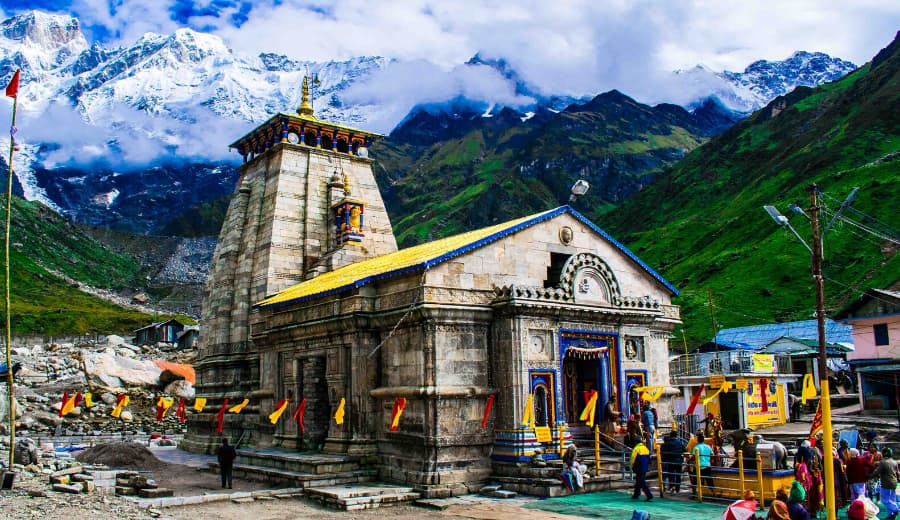
One of the holiest pilgrimage sites of Hindus, Kedarnath Temple, stands at a height of 3583 m (11755 ft), 223 km from Rishikesh (Indian Origin City) on the shores of Mandakini river, a tributary of Ganga. The word Kedarnath meaning “the lord of the field” is derived from Sanskrit words Kedara “field” and Natha “lord”. This temple is dedicated to Lord Shiva, the protector and the destroyer. Located in Rudraprayag District of India, in the state of Uttarakhand, laps of Garhwal Himalayan range near Mandakini river, this is one of the most beautiful Shiva temples situated in the utmost height.
Kedarnath Temple is one of the 12 Jyotirlingas, one of the Char Dhams (Badrinath, Kedarnath, Yamunotri, Gangotri), and one of the 5 (Panch) Kedars (Kedarnath, Tungnath, Rudranath, Madhyamaheshwar and Kalpeshwar). It is a must visit temple of Lord Shiva, however because of the extreme weather condition and a temple’s location makes it harder for most of the pilgrimages to reach here. Still people believe that visiting this temple once in their lifetime will make their present life and afterlife blessed.
The temple is open to the general public only for 6 months from April (Akshaya Tritriya) to November (Kartik Purnima, the autumn full moon) and remains closed during winter because of heavy snowfall.
Temple’s Legend
This temple is originally believed to be built by Pandavas and later further constructed is said to be done by Adi Shankaracharya about more than 1,200 years ago. Apart from the legend there are no any written scriptures about construction date and the builders. Hence, the history of who built the Kedarnath temple is unknown.
Legend further states that, this place was named as “Kedarnath” in the honor of King Kedar, who ruled this place in Satya Yuga. Around the temple is a jungle named Vrindavan (Vrindavan was the King Kedar’s daughter and the jungle was named ‘Vrindavan’ as a respect to her)
People believe this place to be that holy place where, Pandavas found Lord Shiva and seek for forgiveness for the sin of killing their cousins. After the war in Kurukshetra, when Pandavas won over the Kauravas, they (Pandavas) felt guilty of having killed their kith and kins and sought the blessings of Lord Shiva for reclamation. When Pandavas pursued Lord Shiva to free them from the sins, Lord Shiva hid himself disguising as a bull and went to the Himalayas. Pandavas somehow get to know about the whereabouts of Lord Shiva and started their journey towards present day Uttarakhand, and later they found Bholenath in the form of bull. This is the place where Pandavas succeed in pleasing the Lord and attain get free from their sins.
Temple’s Architecture
According to the committee of Kedarnath and as per the temple websites, there are more than 200 shrines dedicated to Lord Shiva that lies in Chamoli district itself. Whereas Kedarnath is one of the most important holy places of Lord Shiva.
The temple’s architectural structure is as similar as most of the Hindu temples, i.e. Ashlar style of construction. The temple had been interlocked by stone slabs. The inner walls of the temple are decorated with figures of various deities and scenes from mythology where as a large statue of the Nandi Bull stands as guard outside the temple door.
The lingam at Kedarnath unlike the usual form is pyramidal and is regarded as one of the 12 Jyotirlings. Kedarnath is highest among the 12 Jyotirlingas.
Why is Kedarnath Temple Important?
In 2013, the temple town were badly affected during the Kedarnath flash floods and did suffer massive losses. Since the town is located near the Chorabari Glacier, which forms the head of the Mandakini River, it made the worst hit due to the continuous rains that eventually led to the flash floods.
However, the Kedarnath temple that is built on the banks of Mandakini and the mythical Saraswati rivers was not even slightly damaged. Since then, Kedarnath is more cherished and had become one of the most visit destination for thousands of pilgrimages.
Every year, millions of Hindu pilgrims’ flocks are visiting the temple to seek the blessing of Lord Shiva.
The Shiva statue in Kedarnath is said to be ‘without a head’
It is believed that, the Shiva statue in Kedarnath is examined to be executed. The head of the statue is believed to be in Doleshwor Mahadeva Temple in Bhaktapur, Nepal
Where are the other parts of Lord Shiva’s ‘Bull’ statue in Kedarnath?
Pandavas sought for Lord Shiva’s forgiveness to forgive the sins considered by them during Mahabharatha war and left for Kashi to look for the Lord Shiva whereas Lord Shiva cover from them by transfiguring himself into a bull. Therefore, Pandavas follow him from Kashi to Uttarakhand. On their way to Uttarakhand, Nakul and Sahdev found a unique bull, Bheema went after the bull with his mace and hit the him. In this complete incident, the bufallo’s head went straight to Nepal leaving the behind/secret part in Kedar.
Near the Temple lies the protector of Kedarnath Temple
Near Kedarnath temple lies Bhairon Temple, where god Bhaironathji is ceremoniously worshipped at the opening & closing of Kedarnath. The belief is that he protects the land around Kedarnath from evil during the time when temple of Kedarnath is closed.